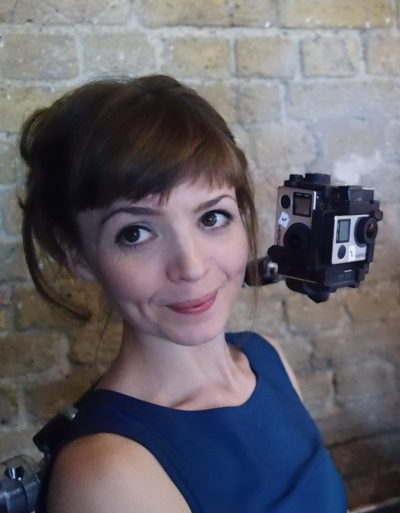
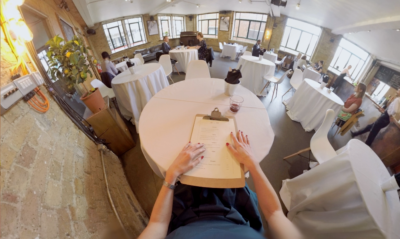
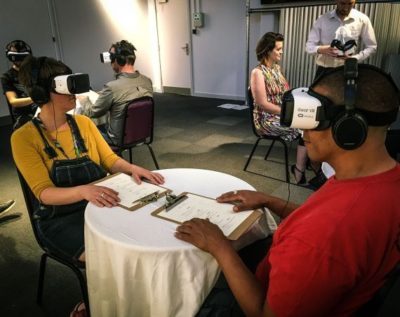
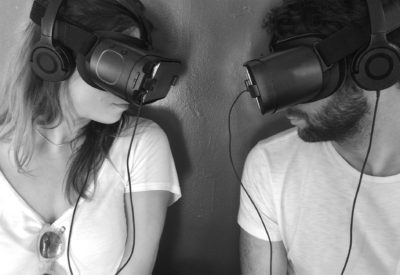
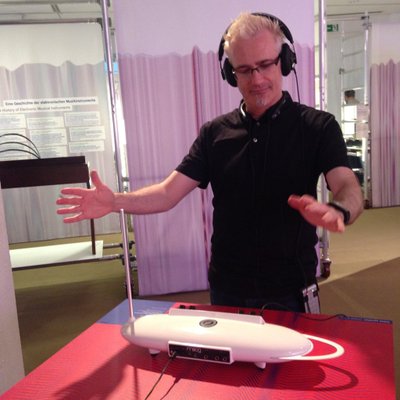
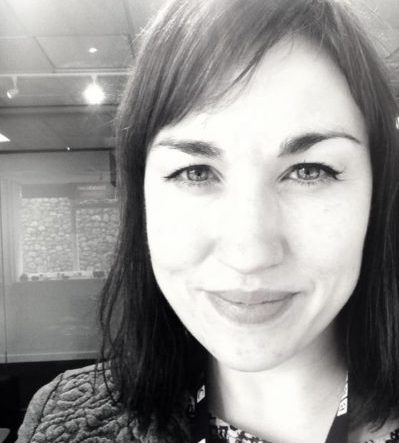
Today we have two special guests in studio, Jane Gauntlett & Tessa Ratuszynska. Jane is a writer for film and theatre. She experiments with new technologies, focusing on designing high-impact experiences with a strong narrative. In 2011 Jane founded the In My Shoes Project, an ever-expanding library of interactive experiences which use story, theatre, audio-visual technology, virtual reality and first person documentary to recreate real-life experiences.
Tessa is a documentary filmmaker, installation artist and creative producer for virtual reality and performance. She is a producer of new media documentary, with particular creative focus in virtual reality, 360 documentary and has a passion for the potential for affecting works of interactive non-fiction. In My Shoes: Intimacy was written and directed by Jane and Tessa was creative producer.
In this episode we speak about early adoption of VR, the advances in technology and keeping ahead of the curve. We discuss reaching out to younger audiences, the importance of not using technology for the sake of it and this new technology as a platform for immersive storytelling.
In today’s episode we’re joined by James E. Marks, an experimental new media provocateur. He is a creator of award-winning social video edutainment, and maker of immersive mixed and virtual reality experiences. With over 20 years of hands-on collaborations with alternative, pop culture branded and unbranded entertainment, James is Co-Founder & Chief Marketing Officer for DoubleMe, a Silicon Valley transformative tech start-up that’s pushing the boundaries of holographic mixed reality. He is also the founder of PsychFi Lab & Hackstock Festival. At PsychFi, he collaborates with the biggest social video & moving image artists, exploring immersive tech, psychology, psychedelia, sci-fi and pop culture.
In this episode we discuss the importance of sound and all senses in an immersive experience, new technology and how it has changed the approach to composing.
Today Oliver is joined in the studio by Professor Damian Murphy. Damian is a Professor of Sound and Music Computing at the Department of Electronic Engineering, University of York, where he has been a member of academic staff since 2000, and is the University Research Champion for Creativity. He started his career in the Performing Arts Department at Harrogate College and has previously held positions at Leeds Metropolitan University and Bretton Hall College.
His research focuses on virtual acoustics, spatial audio, physical modelling, and audio signal processing. This research formed the basis of the Surrounded by Sound project that was selected for inclusion in the Royal Society’s Summer Science Exhibition in July 2001, and he was also co-author of SoundFX – Making Music with Technology, the 2004 IEE touring Faraday Lecture.
He has been principal investigator on a number of AHRC and EPSRC funded projects relating to room acoustics simulation and auralisation, and published over 130 journal articles, conference papers and books in the area. He is a member of the Audio Engineering Society, a Fellow of the Higher Education Academy, and a visiting lecturer to the Department of Speech, Music and Hearing at KTH, Stockholm, where he specialises in spatial audio and acoustics. He has held visiting researcher status at a number of universities internationally.
Prof. Murphy is also an active sound artist and in 2004 was appointed as one of the UK’s first AHRC/ACE Arts and Science Research Fellows, investigating the compositional and aesthetic aspects of sound spatialisation, acoustic modelling techniques and the acoustics of heritage spaces. His work has been presented in galleries nationally and at festivals and venues internationally and included varied collaborations with writers, photographers and interactive digital artists. He is a founding member of Geodesic Arts through which most of his more recent work has been produced.
In this episode, Damian discusses entering into academia and recreating the acoustics of environments.
In today’s episode Oliver was joined via Skype by Aaron McLeran, Lead Audio Programmer at Epic Games. Aaron’s first taste of audio programming was writing computer music in CSound while in graduate school at University of Notre Dame (when he was supposed to be doing astrophysics research). Realising his true calling, he left physics to study procedural and interactive computer music, audio synthesis, and audio analysis with Dr. Curtis Roads at the University of Santa Barbara. His first game audio experience was writing procedural music on Spore where he got to collaborate with Brian Eno and Maxis’ audio director Kent Jolly on writing much of the game’s truly procedural music. His next game audio gig was a sound designer on Dead Space 2 where he wrote much of the games interactive audio systems in Lua along with accomplished audio director Don Veca. He made the leap from technical sound designer to audio programmer at Sledgehammer Games where he worked on Call of Duty: Modern Warfare 3 and Call of Duty: Advanced Warfare. His next audio programming gig was at ArenaNet where he got to wrangle with the unpredictability and scale of game audio in the context of an MMO and developed some pretty cool tech around for player-created music and musical interaction. He’s currently working on a new multi-platform audio mixer backend for UE4 and developing new tech and approaches to game audio for VR.
Aaron speaks to Oliver about all things Game Audio and Procedural Audio and his unusual entry into the industry.
In today’s episode we are joined in studio by Catherine Robinson, Audio Supervisor at BBC Wales. Catherine has worked in radio sound for the BBC since 2001. Her specialism is sound design for radio drama, binaural audio and 3D sound for 360 video and VR. Catherine created the sound design and binaural mix for Ring, a horror radio drama for Radio 4. Following the success of that, Catherine has set up the first operational 3D sound studio in the BBC outside Research and Development, using their tools.
Some of the binaural productions that have been created in the 3D studio are: The Russell T Davies adaptation of A Midsummer Night’s Dream, which was the first ever binaural feature film; six 360 films for Planet Earth 2 using dynamic binaural sound design; and an episode of Doctor Who called ‘Knock Knock’ which is the first binaural TV drama to be made available on BBC iPlayer.
Catherine discusses her role at the BBC, the first binaural episode of a TV program available on the BBC iPlayer – Doctor Who, how content will drive immersive audio consumption and bringing immersive audio to the masses.
Today we are joined in the studio by Samuel Huber, the founder of Admix.in, the first adtech platform for mixed reality, giving VR, AR and MR developers the best tools to monetize their content. He frequently speaks at VR, AR and adtech conferences and is obsessed with the convergence of frontier technology, adtech, and consumer behaviour. Sam has previously disrupted the e-commerce market with Kout.io, a gamified e-commerce platform where users play free games to win their shopping basket, live with 20 of the largest retailers. He is a social gambling pioneer with Betify, a gamified video sharing app. He built and sold Rogue Trader, the first binary trading game on the App Store. In a previous life, Sam was responsible for Mercedes Formula 1 engine strategy (season 2011/2012). He has a MSc Engineering from Cranfield
Uni (UK), BSc Physics from EPFL (Switzerland) and Uppsala Uni (Sweden).
Sam discusses Admix and advertising in a non-intrusive way, monetisation solutions and the importance of audio in VR advertising.
In today’s episode we are joined by Sally-Anne Kellaway via Skype. Sally is the Senior Audio Designer on the Microsoft Mixed Reality – Audio and AI team, and an industry leading VR Audio Evangelist.
She has extensive experience in sound recording, editing, implementation and testing for interactive media in standard and VR/AR and has an interest in implementing true 3D spatial hearing and binaural sound in video games and other interactive experiences. She is the founder of the Virtual Reality Content Creators Network of Australia (VRCC) which is a not for profit community for virtual reality and associated industries. The VRCC advocates for innovation and connection for all professionals working in virtual, augmented and mixed reality industries in Australia.
Previously the Creative Director at OSSIC, the leading audio technology providers active in the VR space, she has a Masters in Acoustics with a focus on psychoacoustics and spatial audio from the University of Sydney. Sally-Anne is sought after by VR and AR developers, Software and Middleware developers, Conferences, Meetup Groups and Panels to develop and consult on sound design, implementation, tutorials and presentations. She is the Founder of the Women/NB in VR Group for Australia and co-organiser of the San Diego VR community group and is on the AES Technical Committee for Game Audio (Spatial Audio) and on the Diversity and Inclusion Working group.
Sally is a vocal advocate for VR, AR and MR as the future of audio, entertainment and industry and uses her education in Sound Design, Acoustics and Psychoacoustics to rise the tide for all audio professionals passionate about the future.
In this episode, Sally-anne speaks about head-tracking, the future of Audio AR, and diversity in the industry.
Michael Kelly is Senior Director, Research and Development at DTS and is responsible for spatial audio SDKs used in games, AR, VR and other media. Kelly is also co-chair of the AES Technical Committee on Audio for games and chairs the AES Audio for Games conferences. He has over 15 year’s experience in the games industry working on both the creative and technical aspects of games. Michael began his career as Lead Sound Designer at Revolution Software working on Broken Sword: The Sleeping Dragon. Following this, he was responsible for the implementation of high quality DSP effects on a number of platforms at Creative Labs and led 3rd-party audio tools and high-level library development for PS3 and Vita at Sony Computer Entertainment Europe. He has a PhD in Electronic Engineering from the University of York, specialising in 3-D audio and Audio Coding.
Justin Paterson joined us in the studio for today’s highly informative episode. After leaving silicon chip design, Justin worked as a session drummer for a number of years in the 90’s playing on releases, TV and radio before moving to synthesis, production and composition. His research on many aspects of music production and audio technology has been published widely. He has written for, given tutorials to, and peer-reviewed for the AES in the UK, US and Europe. In 2014, He was awarded an AHRC grant to develop an App release-format for music albums with interactive playback, a system that is currently patent pending and undergoing further AHRC-funded commercial exploitation by the Warner Music Group. Justin also worked with the record label Ninja Tune and the band Coldcut on binaural 3-D (interactive) audio for VR. Justin also reviews books for Focal Press, and is author of The Drum Programming Handbook, and a chapter on 3-D music production in a forthcoming Routledge edition in the ‘ Perspective on Music Production’ series. He is also co-editor of a newly commissioned Routledge book on 3-D audio.
Justin is also co-chair of the Innovation in Music Conference series, and supervises PhDs related to music technology, both in LCM and externally. He is also a practising record producer with commercial releases, and has authored a number of funding proposals relating to 3-D production, that are currently under review.
As well as discussing the above, Justin explains the concepts of ambisonics, binaural audio and head related transfer function (HRTF). We talk about the academic community, immersive audio and the development of technology associated with 3-D audio. Justin speaks about his plan to create a 3D audio research network, to bring together academia and industry and define cross-industrially relevant research questions.
“Success is getting what you want, happiness is wanting what you have, and you have to be very careful not to get those two confused”
In this episode we are joined in studio by one of the leading 3D sound specialists, Henrik Oppermann. Henrik is the founder of Schallgeber and former Head of Sound at Visualise and has worked on over 40 virtual reality projects, capturing binaural audio in a number of challenging environments. He has over 10 years’ experience of recording audio on location for film, advertising, music industry clients and 3D sound installations. An expert in his field, Henrik has developed hardware and software audio applications for VR collaboration with leading sound partners, to deliver the best possible immersive sound.
We discuss higher order ambisonics, the importance of being involved in a project from the early stages and the ins and outs of recording in unusual locations. We ask how and where immersive audio will be used in the future and discuss the mass adoption of VR.
Since the recording if this podcast there have been a number of updates in the mentioned software, for example Avid released an update for Pro Tools HD 12.8.2 which now supports a high channel count.