


Summary
In this episode of the Immersive Audio Podcast, Oliver Kadel is joined by the musician, sound engineer, microphone designer and immersive media producer – Jack Reynolds from London, UK.
We discuss Jack’s extensive career in music and spatial audio, the subsequent move to BBC R&D, UCL, and his own company, Reynolds Microphones. We talk about the importance of ambisonics for location sound and immersive documentary production.
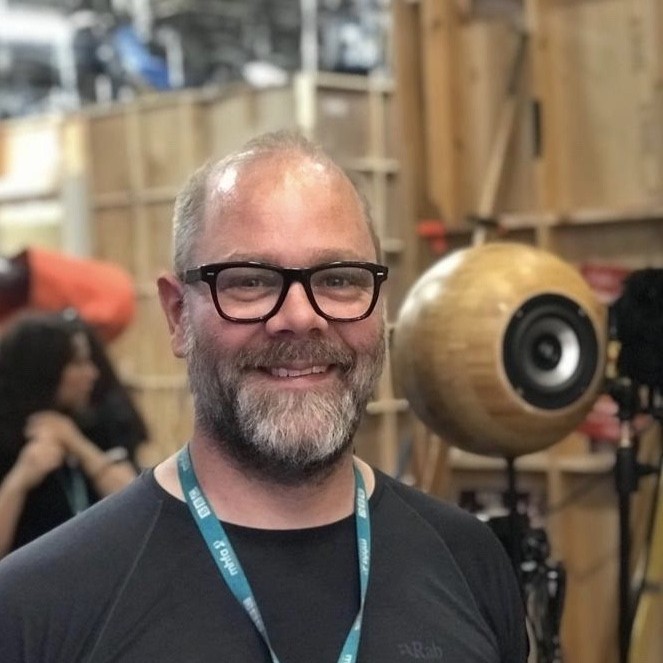
Jack Reynolds founded Reynolds Microphones in 2016, following a diverse and accomplished journey through the music and audio industry. He began as a performer, composer, mix engineer, producer, and studio owner. At just 20, he achieved major label success with the band Jocasta, signed to Sony Music in 1996. Their single Go was A-listed by BBC Radio 1, followed by appearances at major festivals worldwide.
Alongside his musical career, working with artists such as Kieran Hebden (Four Tet) and others, Jack studied music production at Islington Music Workshop. He also worked as a recording engineer, producer, guitarist, and composer at Wendyhouse Studios, collaborating with bands including Geezers of Nazareth, Lowfinger, Human, Dempsey, and many others. This led to roles as a recording engineer for EQ Studios and Fire Records, before he went on to design and build his own facility, Jack In The Box Studios in North London, in 2008.
In 2010, he launched Opal Microphones Ltd, his first venture into developing recording equipment, including the acclaimed OM7 multipattern valve microphone. His growing interest in the science of sound led him to pursue a degree in Electronic and Electrical Engineering at University College London, where he won the Advanced Entrepreneurathon, a milestone that led directly to the founding of Reynolds Microphones.
In parallel, Jack founded Soho VR Audio Ltd in 2016, delivering spatial audio productions for clients including Sky VR, Google, and Nokia, while also completing the BBC Research and Development Graduate Programme.
Today, Jack leads the development of innovative sound capture technologies at Reynolds Microphones, where each product is hand-built in Hertfordshire with a strong focus on precision and quality. Inspired by pioneers such as Georg Neumann, the company has developed a range of high-end microphones, including the R-Type valve series, RM1-V condenser models, and the latest ambisonic A-Type range. Designed for immersive sound capture in virtual reality, 360 video, post-production, and field recording, the A-Type microphones are pushing the boundaries of spatial audio and have become an essential tool for many professionals. Upcoming releases include the O-Type and C-Type miniature omni and cardioid condenser microphones, as well as the S-Type spaced arrays.
Alongside running the company, Jack is also a Senior Lecturer in Spatial Audio Production at University College London, where he contributes to research in immersive audio, live performance in the metaverse, and next-generation sound production, helping to inspire the next generation of audio practitioners. All of this is balanced alongside his role leading immersive media production as Development Producer for BBC R&D’s FWD Team, including recent projects such as The Portal, a series of live volumetric video music experiences for BBC Radio 1’s New Music Show.
Show Notes
Reynolds Microphones Official Website
Listen to Podcast
Immersive Audio Podcast Masterclass
How to access the content from our Immersive Audio Podcast Masterclass series? Head out to our Patreon.
The sessions are designed to enhance your practical learning experience and are delivered by world-class experts. The livestream contains video demonstrations and spatial audio playback with live Q&A. Keep up to date with our upcoming events, announcements and industry news by subscribing to our newsletter.

Survey
We want to hear from you! We really value our community and would appreciate it if you would take our very quick survey and help us make the Immersive Audio Podcast even better: surveymonkey.co.uk/r/3Y9B2MJ Thank you!
Credits
This episode was produced by Oliver Kadel and Emma Rees and included music by Rhythm Scott.